
This article originally appeared in The Daily Scan.
In 2020, Ron Pavlakovic received a heart transplant due to his idiopathic dilated cardiomyopathy, a form of heart disease affecting as many as one in 250 people. Dilated cardiomyopathy causes the heart to enlarge and its normally muscular walls to thin and stretch, affecting its capacity to pump blood. Pavlakovic, a real estate professional, was not getting enough oxygen to his system, and was struggling with everyday activities like climbing stairs.
He was in St. Paul’s Hospital, one of 18 health and long-term care sites run by Providence Health Care (PHC), receiving a routine treatment when he got the sudden and exciting news that they had a new heart for him. At 1 a.m. the next morning, Pavlakovic received a heart transplant – but his old one did not go to waste. He donated it to the Bruce McManus Cardiovascular Biobank in the Centre for Heart Lung Innovation (HLI), at Providence Research, PHC’s research engine.
What is a biobank, and why are they important?
Biobanks are collections of biological samples, such as blood, tissue, and DNA, that are donated for research purposes and are often stored with their associated health data. These valuable resources empower scientific discoveries that improve health care, accelerate medical advancements, and help address pressing global health challenges.

“Creating a biobank is often driven by a clinical need, some clinical demand, some question that remains unsolved in science and medicine,” says Dr. Mari DeMarco, former research director of Providence Research and a clinical chemist at St. Paul’s Hospital.
Biobanks are essential tools for understanding human health and disease, driving innovation in medicine, and improving global health outcomes. They provide a critical scientific resource and means for researchers to access biospecimens donated from patients.
“Biobanks provide invaluable insights into rare diseases and enable the creation of diverse datasets that enhance the inclusivity and accuracy of research, which are key components of precision medicine,” says Dr. Darryl Knight, president, Providence Research. "Biobanking has a huge economic impact, globally valued at around $68 billion in 2021 and anticipated to reach approximately $118 billion by the end of 2031.”
Biobanks drive breakthroughs that can transform how we prevent, diagnose, and treat diseases, ultimately saving lives and improving quality of life for patients worldwide. As part of a unified network, Providence Research provides tools and support for biobank researchers.
Biobanking at Providence Research – our unique focus
Providence Research has a unique focus on biobanking, positioning it at the forefront of research activities. Embedded within St. Paul’s Hospital with direct access to patients, Providence Research is home to a first-in-Canada biobank network collecting a diverse range of samples.
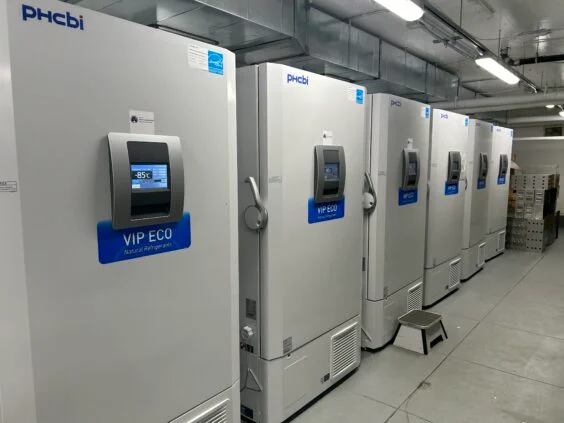
The HLI houses the largest heart and lung tissue biobanks in western Canada, the Bruce McManus Cardiovascular Biobank (BMCB) and the James Hogg Lung Biobank (JHLB). To house these and other specimens, HLI maintains sixty-eight -80°C freezers monitored 24/7 at St. Paul’s Hospital.
The JHLB, directed by Dr. Tillie Hackett, contains more than 90,000 specimens from over 3,000 patients. Established in 1977 by Drs. James Hogg and Peter Paré, it is the longest-running lung biobank in Canada, contributing to over 800 published research projects since its founding. The JHLB has been a leader in establishing lung biobanking research protocols that have been adopted internationally, including methods of preservation that allow the samples to be assessed both structurally and at the molecular level.

The BMCB, directed by Dr. Ying Wang, contains over 100,000 human cardiovascular biospecimens with their clinical information, including 544 explanted hearts from heart transplants,14,000 heart valves, and 600 aorta specimens. Established by Dr. Bruce McManus in 1982, it is the longest-running cardiovascular biobank in Canada.
Protocols for sample collection can vary, but all biobanks at Providence Research maintains the highest ethical and privacy considerations. For example, when an explanted heart is donated to the BMCB, the patient gives consent to donate their heart for research prior to their transplant, and then later gives specific consent for their sample to be maintained in the biobank. This enables the heart to be retrieved within five minutes post-transplant. It is then taken to the laboratory, where it is anonymized and carefully photographed, measured and weighed before being preserved and assessed by a pathologist, after which it is directed to the biobank for longer-term storage. When a researcher requests the tissue, an appropriate biobank sample is identified, processed, and delivered.
Biobanks advance research through two mechanisms: forward translation, where samples are actively collected for a specific study, and backwards translation, where research is done using pre-existing sample collections. The biobanks at Providence Research provide advice on how to best utilize existing samples and work with researchers to develop tailored collection protocols that best fit their needs. They have an adaptable structure that makes it possible to quickly collect samples for emergent situations such as the COVID-19 pandemic, when biospecimens were urgently needed to understand the virus and develop vaccines and other therapies.
We’re on the cusp of a new age in research with the promise of not only treating life-threatening conditions, but discovering how to prevent them in the first place.
It's fair to say that at this bank, deposits and withdrawals are life-changing!
Help turn today’s samples into tomorrow’s cures. Discover how you can support biobank research.