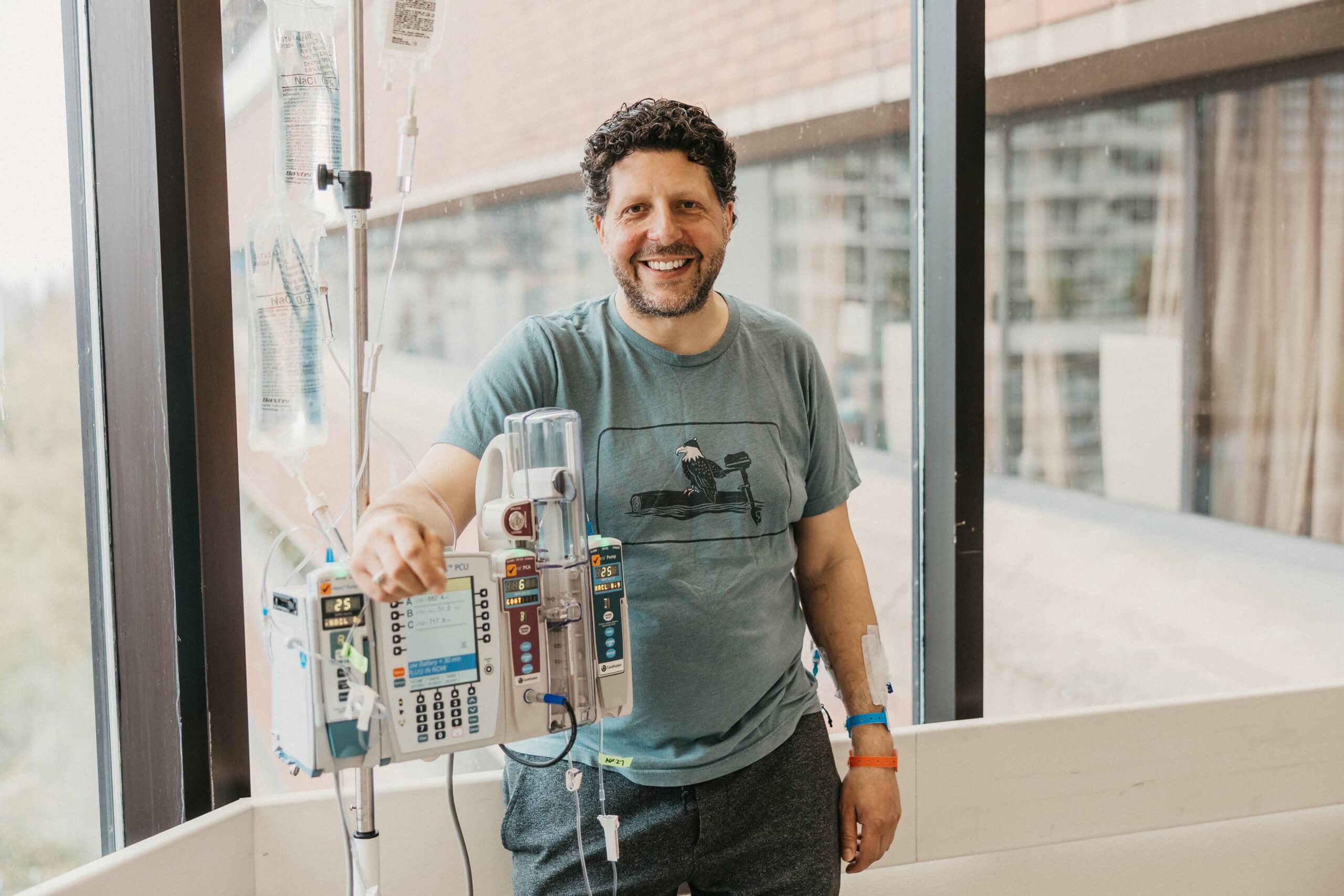
For many parents, packing their children’s lunches can be a dreaded chore. For Angelo Marvuglia, it's a daily miracle – a simple act that once felt impossible during years of relentless pain. Today, thanks to the Leon Judah Blackmore Centralized Pain Treatment Unit at St. Paul’s Hospital – the only one of its kind in Canada – he's living a second chance at life.
An unexpected health crisis
In 2016, Angelo spent six weeks in the hospital. After a virus, he developed double pneumonia, a pulmonary embolism, and pericarditis, which was eventually diagnosed as chronic.
“After that point, I just never felt better—I kept getting worse and having new and different symptoms,” he says.
His chronic pain, focused mostly on the left side of his body, prevented him from working at his family-owned small business, playing with his children and, on many days, simply getting out of bed.
“It was severe pain in all my extremities — burning in my hands, feet, legs, and arms,” he explains. “It felt like hot, heavy sandbags filled with lava that I couldn’t escape.”
Angelo could only move with a four-wheeled walker, spent most of his day sleeping, and took over 100 pills a day. Still, there was no relief.
This went on for years, until one of his cardiologists suggested he may have multiple sclerosis (MS). He was sent to the UBC Hospital MS Clinic, and after an official diagnosis, the MS neurologist referred him to Dr. May Ong at St. Paul’s Hospital. Dr. Ong was determined to find an innovative solution, because the conventional medications just weren’t working.
“Every single thing you can name, Angelo had tried,” she remembers.
She explains that his MS lesions caused sensitivity to touch, poor balance, and daily debilitating pain. Angelo describes it as a seven-to-nine out of ten, and the pain didn’t just affect his quality of life – it impacted his entire family.
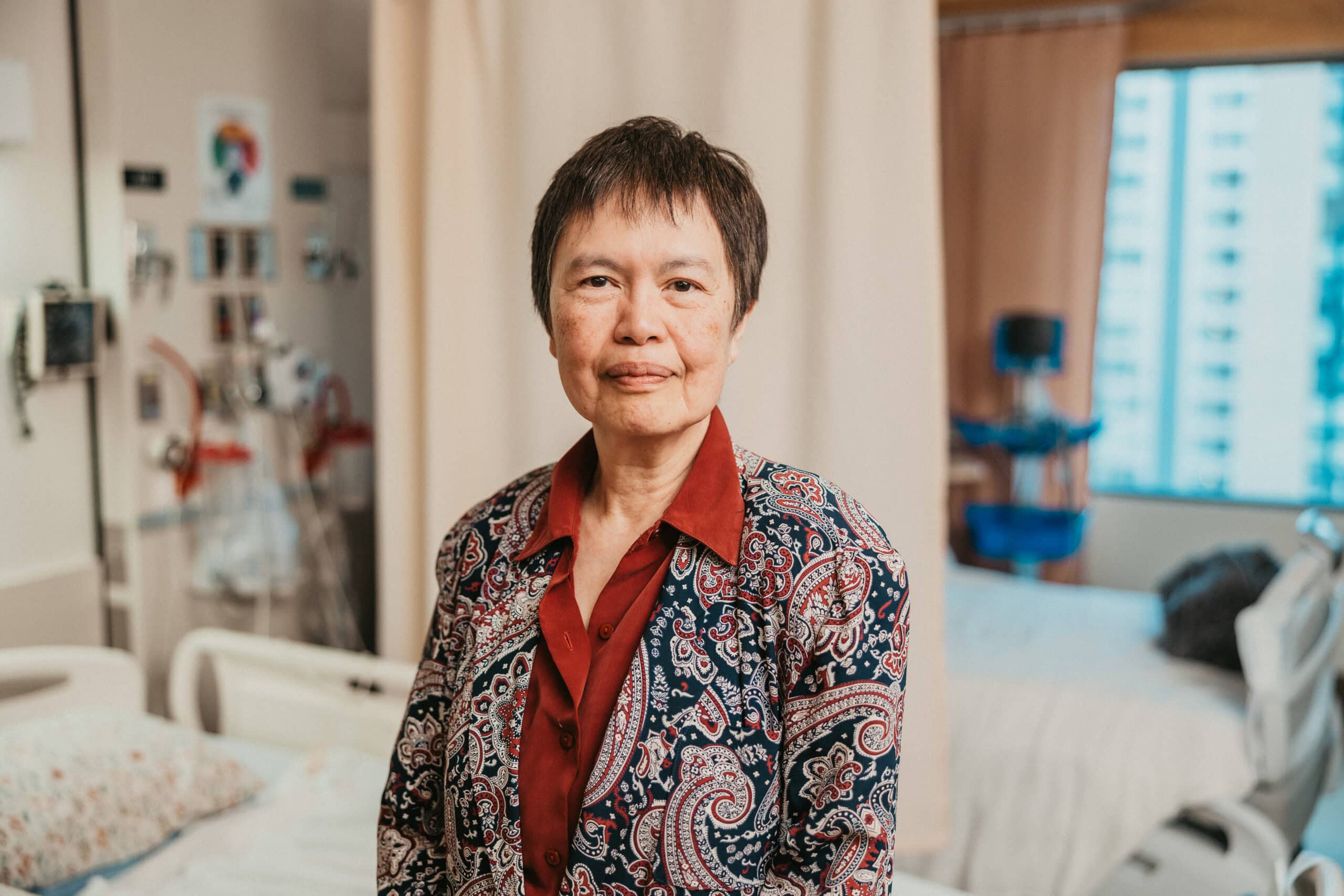
Leading Canada’s first centralized pain treatment unit: Dr. May Ong
Chronic pain like Angelo’s doesn’t always have a clear cause—and it doesn’t just go away. In some cases, a past illness or injury rewires how the brain processes pain, sending constant signals even when there’s no physical reason.
This is called centralized pain, and it requires a specialized approach. At St. Paul’s Hospital, clinician-scientist Dr. May Ong is leading that approach. As Providence Health Care’s Chair in the Neurobiology and Neuropharmacology of Pain, Dr. Ong heads the Leon Judah Blackmore Centralized Pain Treatment Unit, the only one of its kind in Canada.
One of the unit's most innovative treatments is ketamine infusion therapy, designed for patients with central neuropathic pain. Ketamine, originally developed as an anesthetic, works by blocking pain receptors in the nervous system.
In this first-of-its-kind protocol, patients are admitted for 10 to 14 days to receive continuous, low-dose infusions that modulate pain pathways while they remain alert and functional. Every step is carefully monitored to ensure safety and maximize relief.
The life-changing power of ketamine therapy
There’s no such thing as a miracle cure, but what Angelo experienced with ketamine infusions was pretty close.
“Within a couple days, I was feeling a lot better,” Angelo recalls, “and by the end of that first infusion, my pain was down to a two or three out of 10.” Angelo’s body had been sending unprompted pain signals to his brain, and the ketamine helped rewire those faulty signals, creating new neural pathways.
In just under two years, Angelo received four infusions at St. Paul’s Hospital. By the end of his fourth one, his pain levels dropped to zero.
Now, being able to play in the yard with his three children, drop them off at school, cook meals, and go for short bike rides are things he doesn’t take for granted. He’s grateful to Dr. Ong for her mindful dedication to ketamine therapy as a neuropathic pain treatment.
“She's a wonderful doctor who makes time to listen, and she has an incredible depth of knowledge,” Angelo says. “I’m on a second chance at life, and it’s the care I received from the amazing team at St. Paul’s Hospital and Dr. Ong that gave that back to me.”
The future of chronic pain management at the new Jim Pattison Medical Campus

After nearly four decades of specializing in pain management, Dr. Ong has seen the science evolve dramatically – especially in the past decade. Her vision is to expand access to this treatment, deepen research, and inspire similar programs nationwide.
“This is exciting work,” says Dr. Ong. “We want to heal better - emotionally, psychologically, physically – so patients can lead productive lives, including returning to work. Some of my patients have been off work for two, four, even eight years, and now they’re back. That’s just unheard of.”
Today, Angelo works part-time as a table dealer at a casino, a job that requires plenty of speed, dexterity, quick thinking, and confidence.
“Everything has to be done perfectly; it's a challenge, but I enjoy it,” he says. “I think some of my coworkers think I'm a bit crazy for loving my work the way I do, but they haven't been through the same experiences as I have.”
The Jim Pattison Medical Campus, home to the new St. Paul’s Hospital and Clinical Support and Research Centre, will push the boundaries of what medicine can achieve and improve access, comfort, safety, and healing for patients and families. It will be a medical campus where care wraps around every patient and innovation transforms lives.
Looking ahead, Dr. Ong sees limitless possibilities for collaboration and innovation in chronic pain management.
“We’re going to continue to expand research opportunities and work with different fields of medicine to find new ways to quiet overactive pain pathways – not just with ketamine, but with other emerging therapies,” she says. “The opportunities are incredible, especially as we move into our new hospital.”
Your donation will help St. Paul’s Foundation provide compassionate care to patients and residents, support life-changing research, and realize the full vision of the new Jim Pattison Medical Campus.