Published Promise 2025
Jenna Pullen woke up in excruciating pain. She couldn’t move her neck and, when she finally crawled out of bed, she began pacing her home like a wild animal, not knowing what to do.
The pain in her shoulder and neck had been bothering her for a while, but she thought she could manage it with over-the-counter pain killers. Now it was worse–far worse. She needed help, and fast. But the nearest hospital had a nine-hour wait time. That seemed unbearable. So, Jenna asked her husband to drive her downtown, to St. Paul’s Hospital.
“I admit, I had negative preconceptions about emergency departments,” she says. “I was already so anxious.” In her work as a caregiver, Jenna had taken others to hospitals where she witnessed how assumptions about addiction could lead to hasty, incorrect diagnoses. Now, here she was, desperate for pain killers at three in the morning. What if similar judgements from hospital staff delayed her care and extended this terrible pain? What if she was told to just go home and take more Tylenol?
Those anxieties disappeared when Dr. Robert Saona arrived. “He was friendly, direct, and had such a calm demeanor,” Jenna remembers.
“How would you rate this pain on a scale of one to ten?” he asked.
“Ten. If I could saw off my arm to stop this pain, I would.”
Jenna was given the meds she needed straight away. Next, she was given a CT scan, and Dr. Saona set Jenna up with an MRI and an appointment with a neurologist. These were vital steps: imaging revealed that a disc had popped out and was pinching on a nerve in her neck, causing that unbearable pain.
“Dr. Saona walked me through everything; he made sure I had a way to get home. And he actually called me to follow-up before my own GP even called me back,” Jenna says.
Jenna was able to leave St. Paul’s Hospital by 11 a.m. “I’d been around all these people who were very upset, some of them even getting aggressive toward the doctors,” she remembers. “And I kept thinking: these doctors are dealing with this all day, and yet they go above and beyond. No matter who they deal with, their demeanor is calm and doesn’t change.”
She was one of hundreds of patients who came through the Teck Emergency Centre that day. About 100,000 patients receive care there every year. And, as British Columbia’s population continues to age—and access to primary care remains difficult—the traffic is only increasing.

Care at the Teck Emergency Centre is often brief. In mere moments, caregivers like Dr. Saona must establish trust, diagnose needs, and help deliver patients toward their best possible outcomes. Few realize that those speedy answers and vital solutions are possible because another kind of work is also underway: long-term research projects with results that guide each doctor’s decisions.
Dr. Frank Scheuermeyer, director of research in the Teck Emergency Centre, leads a team of five clinician-scientists. These are curious, detail-oriented physicians who coordinate between their own research teams, research partners, patients, and other physicians. The team published fifty papers in medical journals in 2024 alone. Often their work focuses on patients with heart problems, skin infections, substance use or mental health issues.
“Each time we undertake a research project, the important question isn’t can we publish this somehow but, rather, how will this help patients, their families, caregivers and our health care workers.”
Dr. Frank Scheuermeyer, Director of Research at the Teck Emergency Centre, highlights the patient-centred focus of their work.
Despite the hectic pace of work in the Teck Emergency Centre, it’s crucial that research be given space, too. “We are studying patient care; we are studying safety and efficiency,” says Dr. Scheuermeyer, “and we are studying the processes and flow that help our Teck Emergency Centre function.” Their research questions (often suggested by co-workers) are pursued in a real-world, practical environment that offers data impossible to gather in a laboratory.
That work—like the care of patients—is more challenging in a cramped and outdated space. The aging department where doctors like Saona and Scheuermeyer currently work was designed to handle about 65,000 annual patients (two-thirds the current load). The resulting crowds and lack of privacy make research far more difficult; Dr. Erin Kenny, head of the Teck Emergency Centre, explains that the work “falls lower on the list of priorities.” She adds, “much research is done by these doctors off the side of their desk at home.”
Research is critical for health care providers to discover new, innovative treatments and save more lives. “Careful research can more objectively guide the best decision-making, ” says Dr. Christenson. “We’re human, and we need science to guide us.”
That guidance is about to become far stronger at the new St. Paul’s Hospital on the Jim Pattison Medical Campus, where a number of improvements will enhance both care and research.
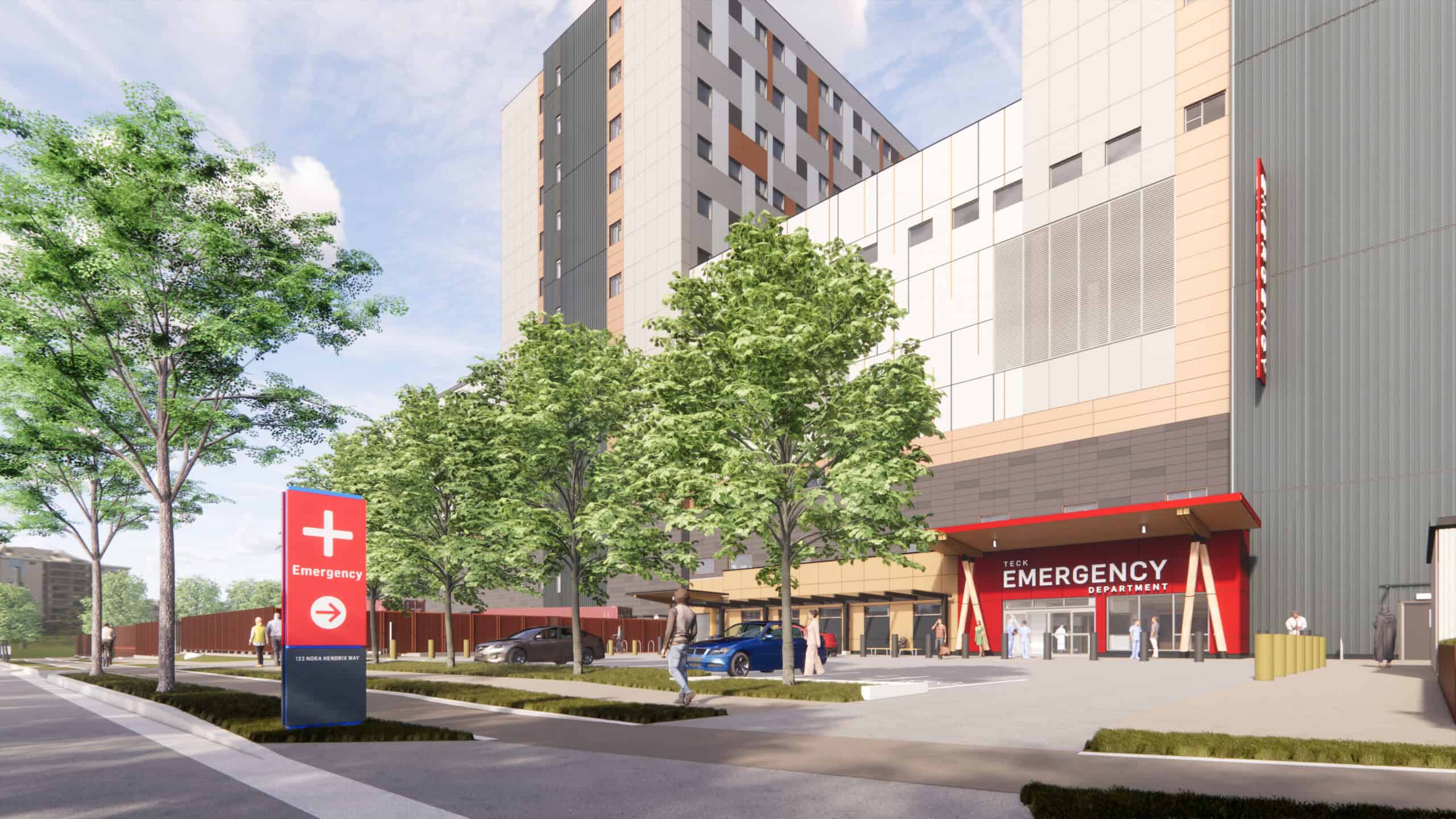
When a patient like Jenna arrives at the triage desk of the new Teck Emergency Department, they’ll be greeted by a streamlined registration where clerks and nurses process patients in tandem. Much of registration will, in fact, be done at the bedside, speeding the path to treatment.
The number of emergency rooms will be increased by 25%. Each room will be equipped with physiological monitoring, bedside speakers for instant communication, and proper walls (rather than curtains). Each room will also be an “all acuity” room (whereas the old hospital’s rooms were relegated to one type of care). And Dr. Kenny says the new, efficient design aims for “all care to be brought to the patient. There’s no more ping-ponging from one space to another and back to the waiting room.” Speed, privacy, and compassionate care can all be elevated.
Consequently, research can improve, too. “In the new St. Paul’s Hospital, there will be more room and time,” says Dr. Kenny. The Jim Pattison Medical Campus will also be home to a brand-new, 12-storey Clinical Support and Research Centre (CSRC), co-joined with the hospital. This innovation hub will include wet labs and dry labs where the hospital’s researchers can continue their work in a calm, dedicated space, and bring discoveries from bench to bedside more quickly.
This new reality—a revitalized Teck Emergency Department paired with a dedicated Research Centre backed by the medical campus’ leading experts and state-of-the-art resources—will bolster and amplify our team’s work. What’s more, by ensuring that research continues to be a fundamental part of the Teck Emergency Department’s daily shift work, those crucial insights and breakthroughs will improve care for every emergency patient who visits us in the years to come.
Breakthroughs in Emergency Stroke Care
During an ischemic stroke, when the brain’s neurons are deprived of oxygen, every second counts, says Dr. Jim Christenson. He led a six-year study of Nerinetide, which slows down neuron death, giving doctors crucial extra time to deal with blood clots. In this trial, Nerinetide was administered in ambulances while patients were still en route to a specialty stroke centre. Not only did the trial prove Nerinetide’s efficacy, it also proved that paramedics are perfectly capable of delivering such drugs. They may, indeed, be best positioned to administer Nerinetide, since they can deliver it earliest. “It’s a game changer,” says Dr. Christenson. “And the study is a real credit to those paramedics.”
Your generosity fuels the future of emergency medicine. Support the new St. Paul’s Teck Emergency Department and help bring life-saving research and compassionate care together—when every second counts.